Introduction
Privacy, passage, and dummy door handles each serve a specific purpose, so before making a purchase, you should clearly determine which function you need for each specific room. After all, some handles are purely decorative, others are designed to ensure privacy, and still others allow you to move freely without needing keys or turning a latch.
Next, we’ll take a detailed look at how these three types of door handles differ, suggest the best locations for each, and offer practical advice to help you choose the most suitable option.
Quick comparison: Privacy vs. passage vs. dummy handles
Although these handle types may look nearly identical from the outside, their internal mechanisms differ significantly.
|
Handle type |
Function |
Locking mechanism |
Best for |
|
Privacy |
Provides privacy and restricts access when needed |
Interior lock with emergency release |
Bathrooms, toilets, bedrooms, home offices |
|
Passage |
Allows free movement between rooms |
No lock; includes a latch to keep the door closed |
Living rooms, kitchens, hallways, closets, laundry rooms |
|
Dummy |
Decorative or pulling function only |
No latch, no lock |
French doors, pantries, decorative doors, cabinets, storage rooms |
What is a privacy door handle?
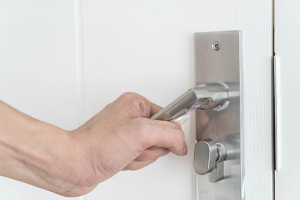
The privacy door handle is designed for spaces where residents occasionally need privacy but do not require a complex lock-and-key system. It combines convenience and security, allowing the door to be locked from the inside while still ensuring access in emergencies.
How it works
A privacy door handle securely locks from the inside via a push-button or turn-knob but lacks a traditional key, allowing it to be opened from the outside using a simple, flat-tipped tool during emergencies.
Where to use privacy handles
Privacy door handles are best suited for spaces where people expect temporary privacy, including:
-
Bedrooms.
-
Bathrooms.
-
Toilets.
-
Guest rooms.
-
Home offices.
What is a passage door handle?
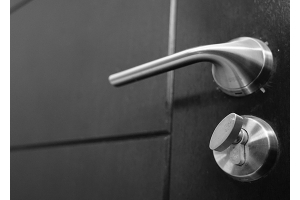
A passage door handle is designed for interior doors that do not require locking. Although it looks similar to a handle with a lock, it does not contain any locking mechanisms (only a latch).
This hardware is considered one of the most versatile.
How it works
Unlike dummy handles, passage ones are equipped with a latching mechanism. When the door is closed, the latch engages with a strike plate in the door frame, securely holding the slab shut.
Turning the knob or lever retracts the latch, allowing the door to be opened. Since there is no lock, the handle can be used freely from either side at any time.
This simple mechanism provides convenience while preventing doors from opening unintentionally.
Where to use passage handles
Passage handles are ideal for rooms where privacy is not a concern, such as:
-
Hallways.
-
Living rooms.
-
Kitchens.
-
Closets.
-
Laundry rooms.
-
Dressing rooms.
What is a dummy door handle?
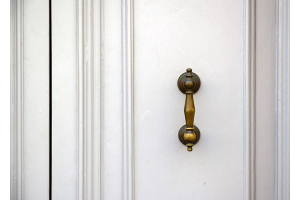
A dummy door handle serves a completely different purpose from privacy and passage models. Rather than operating a latch, it functions primarily as a decorative or pulling handle.
Because it contains no internal mechanism, a dummy handle does not turn and cannot lock or latch a door.
How it works
Dummy handles are surface-mounted directly onto the door. Since there is no spindle, latch, or locking assembly inside, they remain fixed in place.
Their sole purpose is to provide a grip for pulling or pushing a door. So they contribute more to the door's visual design than to its operation.
Where to use dummy handles
Dummy handles are commonly installed on:
-
French doors.
-
Pantry doors.
-
Decorative doors.
-
Cabinets.
-
Storage rooms.
-
Inactive door slabs in double-door systems.
How to choose between privacy, passage, and dummy handles
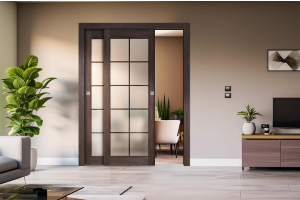
Choosing the right door handle is much easier if you focus on the room’s purpose and how the hardware complements the interior design.
Choose by room function: privacy, passage, or dummy
If privacy is important, choose a handle with a lock. If the room requires unrestricted access, a handle for passage doors is usually the best option. For decorative doors or non-functional door slabs, a decorative handle will provide the desired look without unnecessary mechanisms.
Choosing the right style and finish for each handle type
Although functionality is always the top priority, the hardware's appearance also matters.
Our selection features stylish European and American handles in various shapes and sizes from trusted brands. Available colors:
-
Chrome.
-
Satin nickel.
-
Polished chrome.
-
Satin chrome.
-
Graphite.
-
Matte nickel.
-
White.
-
Satin brass.
-
Black.
-
Gold.
-
Bronze.
-
Satin copper.
-
Satin steel.
-
Matt sandblasted.
Knobs vs. levers for privacy, passage, and dummy handles
Levers are generally easier to use, especially for children, seniors, and those who move items from room to room. Knobs, on the other hand, offer a traditional look that suits many classic interiors.
For a detailed comparison of functionality, ease of use, and design aspects, see our guide.
FAQ
-
Can a passage handle be used on an exterior door?
A passage handle should not be used on an exterior door by itself because it does not lock. For exterior doors, a keyed handle or a handle paired with a deadbolt is a better choice.
-
How do I unlock a privacy handle from the outside in an emergency?
Most privacy handles have an emergency release hole on the exterior side. Insert the supplied privacy key or a small pin to unlock the door.
-
Do I need one dummy handle or two for French doors?
You can use one dummy handle on the inactive door slab if only one side needs a pull. However, two matching dummy handles are often installed to create a balanced, symmetrical appearance.