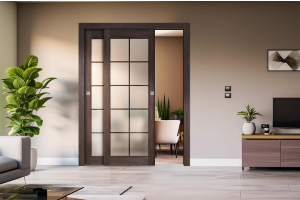
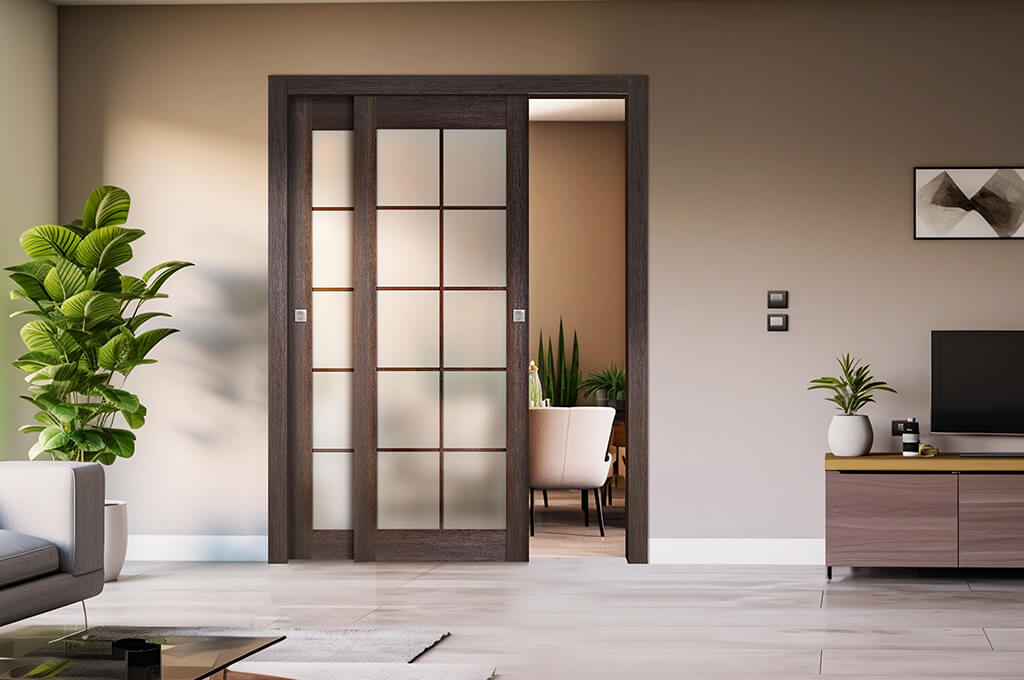
Bypass doors save space without sacrificing functionality. Sliding smoothly along parallel tracks, they work equally well in compact closets, modern room dividers, laundry areas, oversized pantry openings, and other rooms.
But choosing bypass door hardware is not as simple as picking a track. Slab weight, track configuration, material quality, and finish all affect how the system performs over time. The wrong elements lead to noisy operation, sagging slabs, poor alignment, and premature wear.
This guide breaks down everything you need to know before buying bypass door hardware.
Before choosing bypass door hardware: key checks
Before comparing hardware kits or finishes, evaluate how the doors will actually function in your space.
Assess the opening, room use, and door application
Use this checklist before selecting a bypass system:
-
Application: Closet, pantry, wardrobe, laundry room, office partition, or room divider?
-
Frequency of use: Occasional access or multiple daily cycles?
-
Desired aesthetic: Minimalist, industrial, rustic, transitional, or contemporary?
-
Door material: Hollow core, solid core, MDF, or glass?
-
Available clearance: Enough room for this system?
-
Noise expectations: Standard or silent rollers?
-
DIY or professional installation: Please note that certain skills and specific tools are required.
Check door weight, thickness, and slab type
When choosing hardware, two measurements matter more than anything else:
-
Door weight.
-
Door thickness.
|
Interior door type (door filling) |
Approximate weight, lbs |
|
Hollow-core |
20-40 |
|
MDF |
40-70 |
|
Glass |
50-100 |
|
Solid wood |
80-150+ |
Most bypass hardware supports standard interior door thicknesses:
-
1 3/8".
-
1 9/16”.
-
1 3/4".
Step 1: Choose the right bypass door system type
Single-track vs. double-track bypass systems
|
Feature |
Single track system |
Double track system |
|
Door movement |
Doors share one plane |
Doors slide independently |
|
Best locations |
Modern minimal interiors |
Standard closets and wardrobes |
|
Space requirement |
Requires more wall precision |
Slightly deeper installation |
|
Accessibility |
Partial opening at a time |
Easier access to wider door openings |
|
Appearance |
Cleaner, contemporary look |
Traditional bypass appearance |
|
Installation complexity |
Moderate |
Easier for most applications |
Single-track bypass systems create a sleek, architectural appearance. They work especially well in modern interiors and minimalist spaces. However, this configuration requires more precise installation and better wall alignment.
Double-track systems remain the most practical solution for closets and utility spaces. They are reliable, easier to install, and compatible with a wider range of door styles.
Standard-duty vs. heavy-duty bypass hardware
Weight capacity determines how durable and stable the system will be.
|
Feature |
Standard duty hardware |
Heavy-duty hardware |
|
Suitable for |
|
|
|
Average load capacity per slab, lbs |
50-100 |
150-400+ |
|
Best use |
|
|
Step 2: Measure the opening for a proper fit
Measure the door opening
Accurate measurements prevent lots of issues later.
Before ordering hardware, measure:
-
Opening width.
-
Opening height.
-
Side clearance.
-
Ceiling clearance.
-
Floor level variation.
You can find a detailed step-by-step guide from experts on our website.
Calculate bypass door slab width and overlap
Each bypass slab should overlap the adjacent slab slightly to prevent visible gaps.
Recommended overlap is 1-2 inches per slab.
Basic formula:
Opening width ÷ number of slabs + overlap
As a result, proper overlap improves privacy, light control, visual balance, as well as smooth operation.
Determine the correct bypass track length
Most bypass tracks match the opening's total width.
Standard rule:
Track length = opening width
However, manufacturers may recommend additional length depending on the configuration.
Check vertical clearance and floor level
Bypass systems require sufficient clearance above the opening for tracks, mounting brackets, rollers, and soft-close mechanisms.
Typical requirements: 4-8 inches above the rough opening.
Also, check floor conditions carefully. Uneven flooring can create visible alignment problems between slabs.
Step 3: Select hardware material, style, and finish
Once the technical specifications are covered, aesthetics become the deciding factor.
The right finish and material can completely change how the bypass system integrates into the room.
Compare aluminum, steel, and stainless steel hardware
Most often, hardware is made of aluminum, steel, or stainless steel. Each of these materials has its own characteristics and advantages.
|
Material |
Advantages |
|
Aluminum |
|
|
Steel |
|
|
Stainless steel |
|
Match bypass hardware style to your interior
When choosing bypass door hardware, it is just as important to pay attention to it as to the door unit itself. Pulls, tracks, rollers, and other elements should complement the overall interior style, whether it is modern, minimalist, industrial, or classic. Well-selected hardware creates a cohesive look and helps the door system blend naturally into the space, rather than appearing like a purely functional addition.
At the same time, aesthetics should always go hand in hand with reliability and comfort of use. High-quality bypass door hardware ensures smooth and quiet operation, long-term durability, and everyday convenience.
Choose a finish for pulls, tracks, and visible hardware
Our selection includes door pulls with various rosettes (rectangular, square, round) in the following timeless finishes:
-
Satin nickel.
-
Matte chrome.
-
Polished chrome.
-
Satin brass.
-
Black.
Hardware from the renowned brands AGB and Emtek is built to last for years to come.
What’s included in a bypass hardware kit?
100SD sliding bypass door Johnson hardware set includes:
-
1 track.
-
4 ball bearing heavy-duty hangers.
-
4 snap-in door brackets.
-
4 in-track stops.
-
2 angle stops.
-
2 bumper stops.
-
2 door guides.
-
4 heavy-duty floor guides.
|
Max door weight |
200 lbs / 91 kg |
Wheel type |
Nylon encapsulated sealed ball bearing |
|
Min door thickness |
1'' (25 mm) |
Steel component finish |
Zinc trivalent plated |
|
Track finish |
Aluminum |
Steel components |
12-14 gauge |
|
Track material |
Extruded aluminum |
Max track length |
192" (4877 mm) |
|
Track profile |
Box track |
Commercial grade |
Top hung sliding door hardware |
|
Hanger type |
Top mount |
Soft-close mechanism |
Door operation available |
|
Wheel diameter |
1'' |
Soft operation max door weight |
165 lbs / 75 kg |
Bypass door hardware FAQ
-
Can I cut a bypass track to a custom length?
Yes, most tracks can be clipped to the desired length yourself.
-
Do I need a header board for installation?
Usually, yes, especially for heavy doors.
-
How much overlap should bypass doors have?
Typically, 1-2 inches to prevent gaps and improve coverage.
-
Are bypass door systems quiet?
Yes, if installed correctly and equipped with quality rollers and guides.